
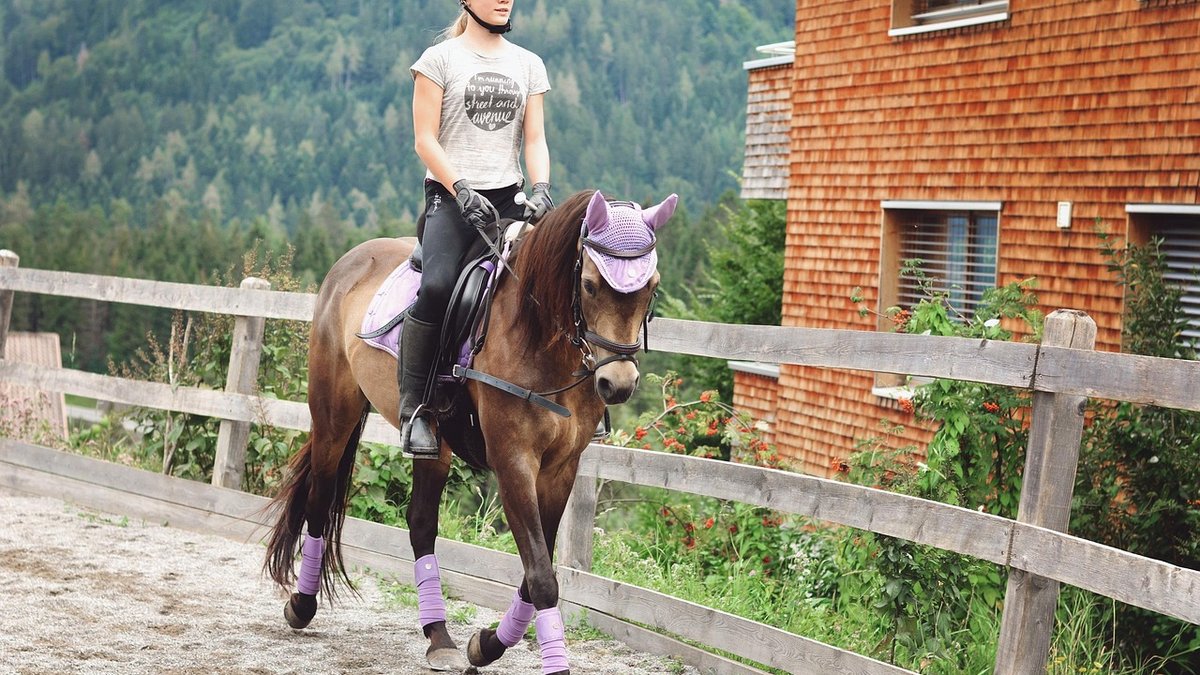
A turnout rug only does its job when it fits properly. Too small, and it pulls across the shoulders, restricts the stride and rubs the coat raw. Too large, and it slides back, drops over the withers and lets rain run straight down the neck. Before you fasten anything, take a soft tape measure from the centre of the chest, along the side of the horse, to the rearmost point of the hindquarters. That figure in inches is your rug size, and most horses fall somewhere between 5'6" and 7'0".
Measure again if your horse has changed weight, been clipped, or come out of winter leaner than he went in. It is also worth measuring both sides, because a slightly asymmetrical horse — and most of them are — can sit comfortably on the left and feel tight on the right. If in doubt between two sizes, go up rather than down, provided the neck opening is adjustable.
The shoulder is where eight out of ten rubs begin. With the rug on and fastened, stand to one side and watch your horse walk away from you on level ground. The front edge of the rug should sit just in front of the shoulder, covering the point of the shoulder without pinching it. You should be able to slide a flat hand between the rug's front edge and the horse's chest.
Watch closely for three things:
Some horses are simply broad across the shoulder and need a style with a shaped or high-cut neck opening. If you find bald patches or scurfy skin on the shoulders after a week, change something — don't wait for the hair to vanish completely.
Neck coverage is a balance between protection and freedom. A standard neck leaves more room to move but lets rain trickle down the neck; a combo or full-neck rug keeps the neck dry but will pull badly if it is too short. Put the rug on with the neck fastened and ask your horse to lower his head to graze. If the rug lifts off the withers, digs into the base of the neck, or the fabric pulls tight across the throat, it does not fit.
Check the withers while you are there. There should be no sagging pocket where rain can collect, and no pressure point pressing down either. A little clearance is fine; a rug sitting hard on the withers will cause a sore, and wither sores are slow to heal in wet weather. A padded wither pad or a rug with a shaped shoulder can make a real difference for a fine, high-withered type.
The cross surcingles do far more work than most people realise. They should form a neat X under the belly, crossing roughly at the midpoint, with about a hand's width — four fingers held flat — between each strap and the horse's belly. Too tight and you restrict the ribcage and create girth-line rubs; too loose and the rug shifts sideways the moment your horse rolls in the field.
Position matters as much as tension. The straps should cross behind the elbow and well in front of the sheath or udder. Sit them too far forward and they catch the elbow with every stride; too far back and they can trap behind the hind leg. Fasten the chest straps first, then work backwards, checking the rug is level on both sides before you tighten anything. If your rug has a front fastening with a shoulder gusset, make sure the gusset opens freely rather than folding in on itself.
Move to the back of your horse. The rear seam of the rug should sit comfortably across the top of the hindquarters, with the tail flap lying flat over the dock rather than hanging in a droopy point below it. A rug that is too short at the back will ride up; one that is too long will sit on the tail and become soiled in minutes.
If your rug has leg straps, cross them through one another before clipping them to their rings — an uncrossed pair can twist and rub the inside of the thigh. Adjust them so there is a couple of inches of slack: enough to allow the hind leg to swing forward without catching, but not so much that a hoof can find its way through. Never leave a leg strap dangling loosely. If the straps annoy your horse or the rug has fillet strings instead, check those daily for mud and fraying.
A rug that fitted perfectly in November can be too tight by February, and one that was roomy on a clipped horse will sit differently once the coat grows back. Take the rug off at least once a day, run your hands over the shoulders, withers, girth area and hindquarters, and look for rubbed hair, heat or scurf. Mud and rain add weight, so brush off dried mud at the neck and belly regularly — a sodden rug pulls downwards and rubs where it hangs.
On very wet days, check that water is not pooling in the neck or running underneath at the shoulder. A well-fitted rug should stay in place through rolling, galloping about and standing in the rain, and you should be able to slide two fingers under every strap without forcing them. Get that right and your horse will stay dry, comfortable and free to move — whatever the weather does next.

Hi, my name is Anthony kuber. I am artist and fashion designer.
I love to travel and writing blogging.
Your email address will not be published. Required fields are marked *
Software Developer & Writer
Hey, I'm Diva, a developer and writer blending code and creativity. I'm driven by a deep curiosity and a relentless pursuit of excellence. Join me as I craft digital solutions and captivating stories.


